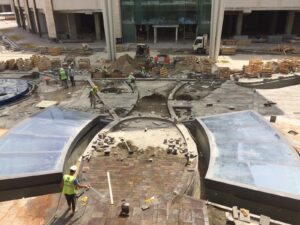

Understanding which porphyry product, size, and thickness to choose for private or public outdoor paving
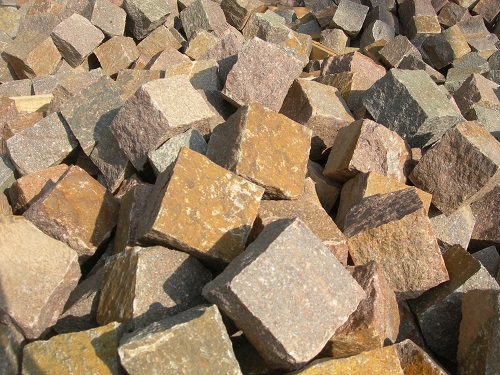
The choice of porphyry paving does not start with the size. First, you need to understand what kind of stress the surface will be subjected to: whether it will be used exclusively by pedestrians, occasionally by a car, or subjected to continuous heavy vehicle traffic—each scenario requires a different solution.
Only after determining the intended use can you evaluate which product— paving stones, tiles, or irregular slabs—is most suitable, along with the size, thickness, installation pattern, and bedding and sealing system.
Private pedestrian walkways are not subject to the same stresses as a driveway. Similarly, a public parking lot, a city street, and a plaza traversed by buses or trucks present very different conditions.
The initial distinction therefore concerns:
The UNI 11714-1 standard associates these conditions with various stress classes, ranging from P.4 to P.9. This classification guides the selection of thickness and installation method, but the design must always take into account the subfloor, anticipated loads, and conditions of use as a whole.
These pavers can be used in both residential and public settings by selecting sizes and laying patterns appropriate for the expected foot traffic.
In residential areas with sporadic automobile traffic, the formats typically used are:
Dimensions expressed as a range indicate the typical dimensional variability of the product. In the case of a 6/8 x 6/8 cm cube, for example, the sides can vary from 6 cm to 8 cm, with a small tolerance due to manual production.
For these pavers, the recommended laying pattern is the alternating arches pattern. If, however, you prefer a parallel-row layout, use square-edged pavers in the sizes 10 x 10 x 4/6 cm or 10 x 10 x 6/8 cm.
The residential sector is classified under stress classes P.4 through P.6. The recommended installation methods are either a compacted bed with sand and cement or a loose-bed installation with polyurethane resin sealing.
As traffic intensity and volume increase, the standard formats also change:
Public pavements are classified into classes P.7 through P.9, depending on the intensity and type of traffic. Up to Class P.8, installation is specified either in a compacted bed with sand and cement or in a loose bed with polyurethane resin sealing. For Class P.9, however, a compacted bed with premixed cementitious materials or a loose bed with polyurethane resin sealing is recommended.
The walking surface remains at the quarry's natural level in both cases. The main difference is in the appearance of the joints:
The choice between the two finishes is therefore primarily aesthetic.
For a private, exclusively pedestrian area, a thickness ranging from 1 to 3 cm is recommended, corresponding to Class P.4. For driveways subject to vehicle traffic, thicknesses of 2–6 cm or 3–6 cm are recommended, within Classes P.4 through P.6.
The tiles can be produced in standard lengths and widths ranging from 10 cm to 40 cm, in 5-cm increments, or combined into modular layouts. This design flexibility is available for both residential spaces and public spaces primarily used by pedestrians.
For public areas subject to vehicular traffic, classes P.7 and P.8 require thicknesses of 5–8 cm and, preferably, widths not exceeding 30 cm.
For Class P.9, tiles are not recommended as the preferred solution: under these conditions, appropriately sized paving stones or setts.
The recommended installation method for the tiles is a compact-bed installation using cementitious mortar up to Class P.8. For Class P.9, the material specifications require the use of high-performance premixed cementitious mortars.
Irregular slabs, also known as "lastrame," are used primarily in private spaces. The types considered are:
In public settings, standard irregular slabs are suitable for sidewalks or small plazas with low traffic volume.
Thin slabs, with a thickness of 1–3 cm, are intended exclusively for pedestrian use and are classified as Class P.4. Normal or standard slabs, with a thickness of 2–5 cm, may also be used in private settings subject to occasional vehicle traffic, in classes P.4 through P.6.
Giant slabs are used primarily in pedestrian and ornamental settings, up to stress class P.6. The installation procedures are the same as those specified for quarry-face tiles.
There is no single "best" format. Making the right choice involves balancing four factors:
Aesthetics remain important, especially when choosing between cut-edge and sawn-edge tiles and when determining the laying pattern for the pavers. However, they must be part of a solution that is consistent with the anticipated loads and the overall structure of the pavement.
Check out the porphyry product sheets to compare sizes, thicknesses, and intended uses.
Contact the Italian Trentino Porphyry Consortium and describe the installation site and the type of flooring you wish to install.


Via Kufstein, 1 - Staircase A, 2nd floor
38121 TRENTO (TN)
Tel. +39 0461 829835
Fax. +39 0461 829838
Email: info@italporphyry.eu
Web: www.italporphyry.eu