Natural quarry face, sawn face, split face, and flamed finish: how the surface of Trentino porphyry is created and how to choose the right one.
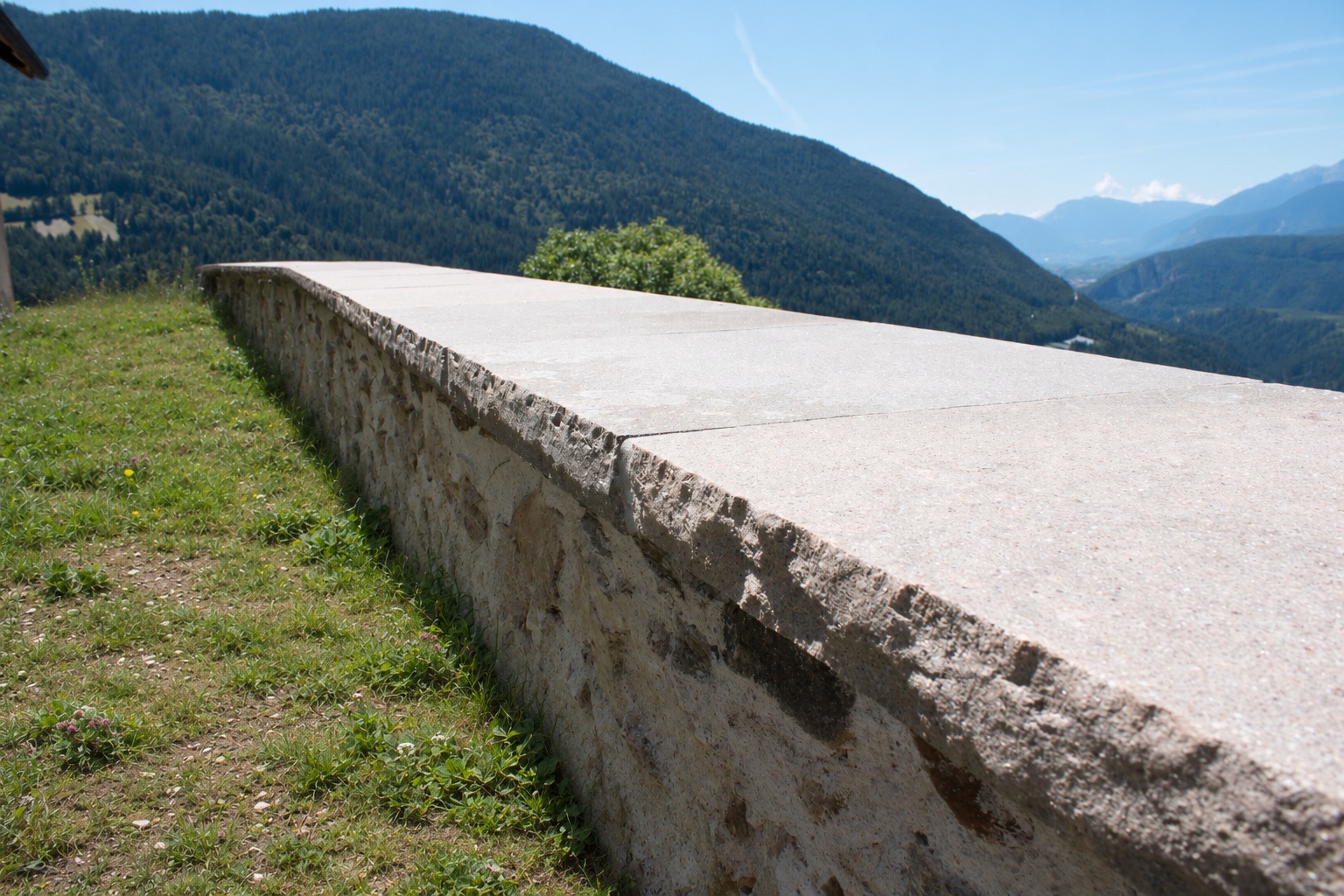
The same stone, two different ways of interpreting its character. Trentino porphyry with a natural finish and flamed porphyry offer different design possibilities, depending on the surface’s origin, the finishing processes, and the characteristics of the finished products. Understanding this distinction helps you make an informed choice when selecting the material for a plaza, a pathway, a staircase, or a cladding.
The distinctive character of Trentino porphyry is evident right from the quarry face. The rock has a laminated structure, with layers of varying thickness that can be separated along natural planes of division—a characteristic that sets it apart from stone materials typically quarried in blocks, such as many marbles and granites.
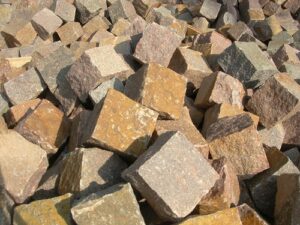
This facility produces a wide range of products: cubes, setts, tiles with sheared or sawn edges, capstones, and irregular slabs. Although they vary in size, thickness, and intended use, these products share one essential characteristic: their exposed surface retains the natural quarry finish.
It is a surface with a rough texture and a characteristic natural flatness, featuring irregularities of varying degrees of prominence that define its identity. It does not require surface grinding before use: subsequent processing steps—such as shearing or sawing—define the product’s edges and dimensions.
The result is a porphyry that retains its original character on its visible surface, both in its color nuances and texture. This quality makes it possible to create orderly compositions without sacrificing the stone’s natural variety.
The versatility of natural wood is evident in a wide variety of architectural settings.
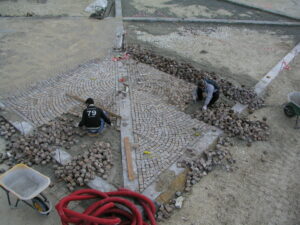
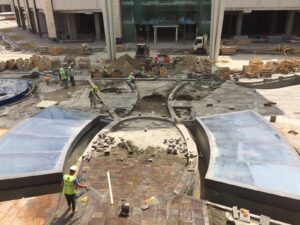
From the “setts ” at Hibiya Tower in Tokyo to the cubes in the Les Halles district of Paris, from the tiles with cut edges in the Noblessner area of Tallinn to the tiles with sawn edges and irregular slabs at Istinye Park in Izmir, the formats, installation patterns, and design language vary.
The common feature is the surface: a natural walking surface, created by splitting the stone along its natural planes of division, without any surface treatment.
In addition to natural-slab products, Trentino porphyry offers a range of products made by sawing compact blocks of limited size.
This process makes it possible to produce components of uniform thickness, which are then subjected to specific surface treatments. Among these, one of the most commonly used is flame-texturing, which may be followed by brushing.
Flaming is a heat treatment that alters the sawn face of the stone, giving it a rough, distinctive texture. The result is a product with a regular shape and a surface that differs from both the natural surface and polished or honed finishes.
This machining process is used for stair treads and risers, solid wood pieces, baseboards, window sills, and flooring slabs. It offers useful options when a project requires consistent thicknesses and precise dimensional coordination among the elements.
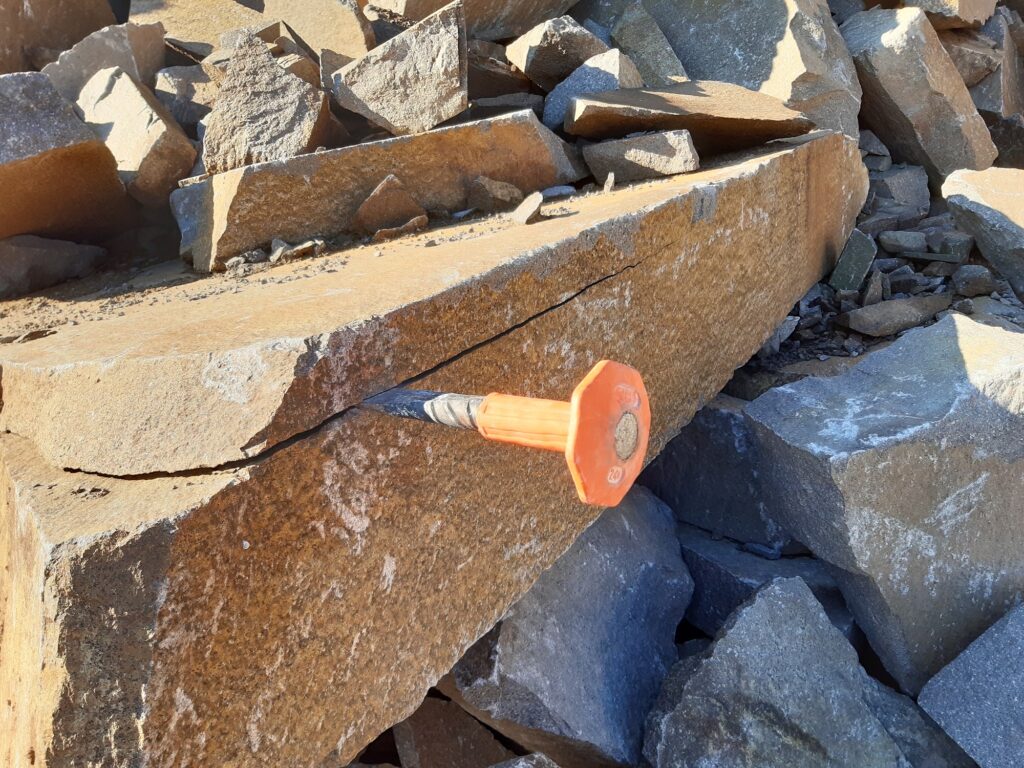
The main difference lies in how the exposed surface is created.
In natural-faced porphyry, the surface is derived directly from the rock's structure and is preserved without further processing. In flamed porphyry, on the other hand, the surface is first cut and then heat-treated.
It is also helpful to distinguish between certain terms that can lead to misunderstandings (other terms are listed in the glossary):
These are, therefore, products with different manufacturing processes, costs, and applications, which should be evaluated based on the desired result.
The natural finish highlights the original structure of Trentino porphyry and its ability to be used as flooring while preserving the quarry face. The flamed finish allows this same stone to be interpreted through slabs cut to a uniform thickness and finished through a heat treatment process.
The best choice results from the interplay between the stone’s character and the project’s requirements. Understanding the differences allows you to define formats, details, and combinations with greater precision, making the most of the possibilities offered by the Italporphyry collection.
Please describe the intended use and the planned products so we can discuss available sizes and finishes.
Via Kufstein, 1 - Staircase A, 2nd floor
38121 TRENTO (TN)
Tel. +39 0461 829835
Fax. +39 0461 829838
Email: info@italporphyry.eu
Web: www.italporphyry.eu