

Porphyry cubes are often improperly confused with Roman sampietrini, and vice versa.
While both are of magmatic effusive origin, they are different rocks not only in composition
petrographic mineralogy, but also in production types and formats that have nothing in common between
them.
In particular, the sampietrino, called flint, is a block of flint (leucitite) historically quarried in
the past in the quarries of the Alban Hills and also defined in this way to recall the very famous
paving of St. Peter's Square in Rome. The sampietrino, which today can only be found salvaged, was
produced manually with a square head and truncated cone shape in 3 main sizes:
- 12 x 12 cm and 18 cm high - that is the best known and most widespread type;
- 12 x 12 cm and 6 cm high;
- 6 x 6 cm and 6 cm high - the latter being very rare but found, for example, in Piazza Navona.
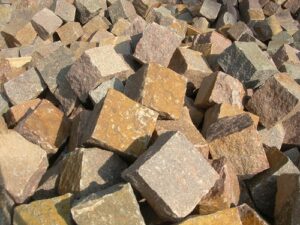
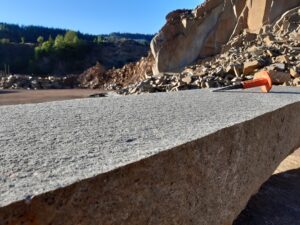
Porphyry cube, on the other hand, is the block obtained from rough slabs of layered porphyry from Trentino, which
are characterized by an unmistakable natural flatness of the upper and lower faces, and which
therefore allow the cube to be made by mechanical splitting and machining of only
four faces that make up the sides.
Porphyry cubes are produced in multiple sizes, among which the types are cm 4/6; 6/8;
8/10; 10/12. The indication in centimeters indicates the possible variation at the same time of all three
dimensions of the cube, that is, the two in plan in addition to the one representing the height or thickness.
Porphyry cubes are also made square-headed in sizes cm 10×10 and height 4/6 cm; cm
10×10 and height 6/8 cm; and finally cm 10×10 and height 8/10 cm.
In conclusion, the differences between sampietrini and porphyry cubes are obvious. This does not mean that the two
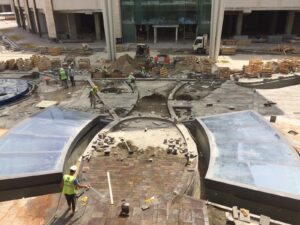
stones cannot coexist in the same pavement and enhance each other. The Temple of
Rome is a very pleasant confirmation of this.